
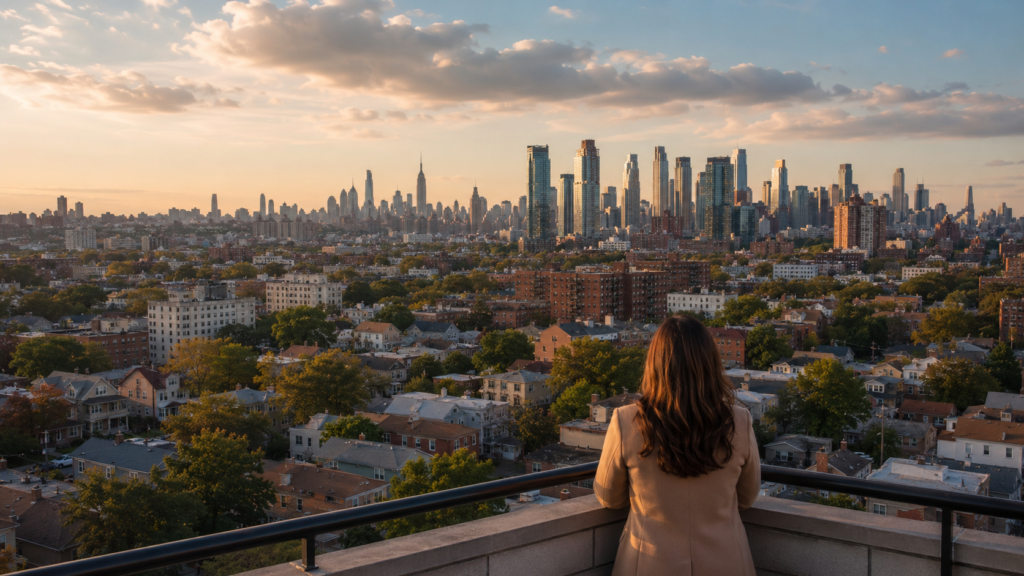
Ask someone to name a Queens neighborhood and you will hear the same handful every time. Astoria. Long Island City. Flushing. Forest Hills. Maybe Jackson Heights if they have eaten their way down 37th Avenue. Those are real places with real value. But they are a fraction of the borough, and buyers who stop there are shopping a sliver of the largest, most varied housing market in New York City.
Queens is not one market. It is closer to forty. A waterfront high-rise in Hunters Point and a single-family home in Bellerose are both Queens, and they have almost nothing in common. Different price points. Different housing stock. Different commutes, schools, and ways of living. The borough rewards people who understand that, and it quietly overcharges the people who do not.
That is the real reason neighborhood knowledge matters here. Not for trivia. For leverage.
Queens Has 61 Neighborhoods… Here’s Where You Actually Want to Live
The Borough Is Really Eight Distinct Regions
The fastest way to understand Queens is to stop thinking in individual neighborhoods and start thinking in regions. Each one has a personality, and once you know which region fits your life, the specific neighborhood gets a lot easier to choose.
The northwest, closest to Manhattan, is the urban core: Long Island City, Astoria, Sunnyside, Woodside. Towers, walk-ups, and the shortest commutes in the borough.
North-central Queens is dense, diverse, and built around food and garden co-ops. Jackson Heights, Elmhurst, Corona, Rego Park. This is where some of the best value in prewar co-op ownership still exists.
The northeast feels like the suburbs without leaving the city. Bayside, Whitestone, Douglaston, Little Neck, and quiet enclaves like Malba and Beechhurst. Single-family homes, strong schools, and water on three sides.
Central Queens is leafy and classic. Forest Hills, Kew Gardens, Fresh Meadows, Jamaica Estates. Tudor streets and substantial homes on real lots.
The southwest is brick and rowhouses with rising value. Ridgewood, Glendale, Middle Village, Woodhaven, Richmond Hill. The buyers priced out of Brooklyn are already here.
South Queens runs along the water and near JFK. Howard Beach with its canals, Ozone Park, South Ozone Park.
Southeast Queens is the borough’s great supply of detached single-family homes, much of it with deep community roots. Queens Village, St. Albans, Cambria Heights, Laurelton, Rosedale, Bellerose, Springfield Gardens.
And then the Rockaways, which most people forget are part of Queens at all. Beachfront from Far Rockaway to Breezy Point, plus the island village of Broad Channel in the middle of Jamaica Bay.
Eight regions. One borough. Wildly different lives available in each.
Why the Smaller Names Are Often the Smarter Buy
The neighborhoods nobody mentions are frequently the ones that make the most financial sense. There is a reason for that, and it is not a secret. It is just unevenly known.
Demand concentrates on the names people recognize. When a buyer fixes on Forest Hills or Astoria because those are the names they know, they compete with every other buyer doing the same thing. That competition shows up in the price.
Meanwhile, a neighborhood like Auburndale, Beechhurst, or Cambria Heights offers comparable housing, real community, and a workable commute, with less of a crowd bidding it up. Same quality of life. Different price tag. The difference is information, not luck.
This is the part of the job that does not fit on a listing site. A search filter can show you what is for sale. It cannot tell you that a particular block in Kew Gardens Hills holds value differently than one ten minutes away, or that a co-op in Sunnyside Gardens comes with rules and a garden that a similar building in another neighborhood does not. That knowledge is built over years of working a market, not pulled from a database.
Match the Region to Your Life, Then Pick the Block
The buyers who do well in Queens get the order right. They decide how they want to live first, then find the neighborhood that delivers it. The buyers who struggle do the opposite. They fall for a single listing and try to make the rest of their life bend around it.
Start with the questions that actually shape the decision. How long a commute can you live with, and to where. Do you want a building with neighbors and shared walls, or a house with a yard and a driveway. Co-op, condo, or a deed in your own name. School district, or no children in the picture. Walk to the train, or comfortable driving everywhere.
Each answer points you toward a region. A short Manhattan commute and a love of restaurants points northwest. A house with a yard and strong schools points northeast or central. The best value in homeownership points southeast or southwest. Wanting to wake up near the ocean points to the Rockaways, which sounds like a fantasy until you see what your money buys out there.
Once the region is clear, the neighborhood almost chooses itself. And that is the moment local knowledge earns its keep, because the gap between two adjacent neighborhoods, or two blocks within one, can be the difference between a smart purchase and an expensive lesson.
The Map Is Bigger Than You Think
The point of all of this is simple. The Queens you can name is small. The Queens that is actually for sale is large, and the opportunities live in the parts most buyers never look at.
You do not need to memorize sixty neighborhoods. You need someone who already has, who can listen to how you want to live and point you to the three or four places that fit, including the ones you would never have searched for on your own.
That is the work. Knowing the whole map, not just the famous corners of it.
Frequently Asked Questions
How many neighborhoods does Queens have? There is no official count, but Queens has more than sixty recognized residential neighborhoods spread across eight broad regions, from Long Island City in the northwest to Breezy Point at the tip of the Rockaways. Boundaries often blur and some neighborhoods sit inside larger ones.
What is the most affordable part of Queens to buy a home? Southeast Queens, including Queens Village, St. Albans, Laurelton, Rosedale, and Springfield Gardens, generally offers the most single-family homes at lower price points. Southwest neighborhoods like Woodhaven and parts of Richmond Hill also offer strong value.
Which Queens neighborhoods are best for families? The northeast and central regions are the most family-oriented, with single-family homes and sought-after schools. Bayside, Douglaston, Little Neck, Forest Hills, Fresh Meadows, and Whitestone are common choices for buyers who want space and quality schools inside the city.
Where in Queens has the shortest commute to Manhattan? Northwest Queens has the fastest access. Long Island City and Hunters Point are one subway stop or a short ferry ride from Midtown, and Astoria, Sunnyside, and Woodside all offer quick, direct trains.
Are co-ops common in Queens? Yes. Queens has a large supply of co-op apartments, especially in Jackson Heights, Sunnyside, Rego Park, Forest Hills, Kew Gardens Hills, and Bay Terrace. Co-ops are often more affordable than condos but come with board approval and specific ownership rules.
Can you really live by the beach in Queens? Yes. The Rockaway peninsula is part of Queens and offers oceanfront living from Far Rockaway through Rockaway Beach to the private community of Breezy Point, with bungalows, condos, and newer beachfront construction. Broad Channel sits on an island in Jamaica Bay.
Should I work with a local agent when buying in Queens? Yes. Queens is dozens of distinct markets, and pricing, housing stock, and value can change from one neighborhood to the next or even block to block. A local agent helps you match the right region to your life and find value in neighborhoods you would not have searched on your own.
If you are thinking about buying or selling in Queens, the most useful first step is a conversation about how you want to live and what your budget actually buys across the borough. I am glad to walk through it with you.
Claudia Looi Licensed Real Estate Salesperson, SRS, ABR, SFR Keller Williams Landmark II 347-612-2964 Schedule a consultation: https://claudialooi.com/consultation/