
Long-term ownership shapes pricing in Queens more than most homeowners realize. While many sellers assume price is determined primarily by square footage, condition, or recent sales, the length of time a property has been owned often plays an equally powerful role. In Queens, where homeowners stay put longer than in most parts of New York City, tenure influences everything from supply levels and negotiation leverage to tax exposure and buyer psychology.
Understanding how long-term ownership affects pricing helps sellers make smarter timing decisions and allows buyers to recognize patterns that are invisible on the surface.
Why Queens Is Different From the Rest of NYC
Queens has one of the longest average homeownership tenures in New York City. The typical homeowner holds their property for 12.7 years, compared to 10.9 years citywide. Single-family homeowners stay even longer, averaging 15.3 years, reflecting strong neighborhood attachment, generational ownership, and a preference for stability over frequent mobility.
This matters because longer ownership reduces turnover. Fewer homes enter the market each year, which tightens supply and quietly supports higher prices, even when broader market conditions soften. Buyers often feel this scarcity without understanding its cause. Sellers benefit from it, but only when pricing and timing align with how long-held homes behave once they finally surface.

Source: Data from Queens homeownership tenure analysis, 2025. Chart ID: chart:95, Property Shark.
How Ownership Length Shapes Buyer Perception
When buyers see a home that has been owned for 15, 20, or even 40 years, they subconsciously assign meaning to that fact. Long ownership suggests stability, neighborhood desirability, and a home that “worked” for someone for a very long time. At the same time, it raises concerns about deferred maintenance, outdated systems, and renovation costs.
This dual perception creates a pricing tension. Buyers often expect a discount for age, while sellers expect a premium for longevity and accumulated equity. The final price depends on which narrative dominates the listing strategy.
Equity Accumulation Creates Pricing Confidence — and Resistance
Long-term owners in Queens often hold significant equity. Over the past decade, Queens home values rose roughly 76 percent, meaning a home purchased for $600,000 could approach or exceed $1 million today, even before accounting for mortgage paydown. This equity gives sellers flexibility and patience. They are less likely to accept aggressive offers and more willing to wait for their number.
This is why some listings appear “stuck” despite strong demand. The seller is not motivated by urgency but by outcome. Equity allows them to test the market, often pricing above recent comparable sales to see whether buyers will meet expectations.
However, equity does not guarantee leverage forever. When life events intervene — retirement, health changes, estate settlement, relocation — even equity-rich sellers can become highly motivated. At that point, pricing often adjusts quickly, sometimes below market expectations, to achieve certainty and speed.
Capital Gains Tax Quietly Controls Supply
One of the most overlooked forces shaping pricing in Queens is capital gains tax exposure. Federal law allows homeowners to exclude $250,000 in gains, or $500,000 for married couples, when selling a primary residence. That threshold has not changed since 1997, even as home prices have risen more than 260 percent.
For many long-term Queens homeowners, selling triggers significant tax consequences. A homeowner who bought for $400,000 and now owns a $900,000 property could face tens of thousands of dollars in capital gains taxes. This creates what economists call a “tax lock-in effect,” where owners delay selling not because they love the home, but because the tax cost feels punitive.
The result is fewer listings, tighter supply, and upward pressure on prices. Homes that do come to market after long ownership often price higher, not just because of value, but because sellers need the sale to justify the tax hit.
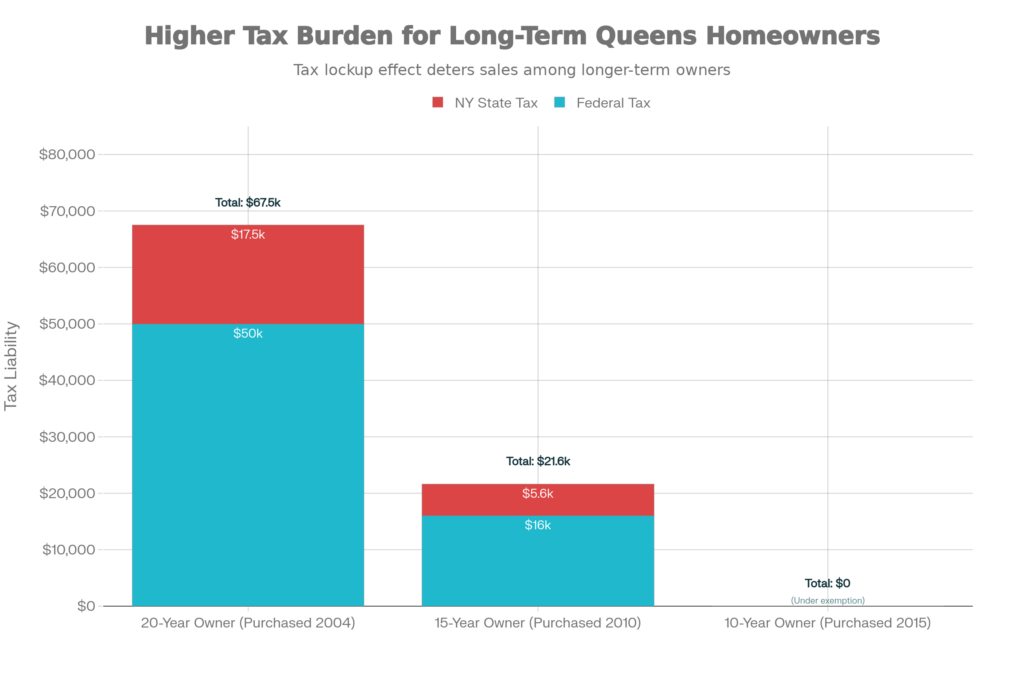
Source: Queens capital gains tax analysis based on 5.6% annual appreciation [chart:96]
Why Long-Held Homes Don’t Always Sell for More
There is a common myth that long-owned homes automatically command higher prices. In reality, tenure only helps when the property condition and market timing support it. Deferred maintenance can erode value faster than equity builds confidence.
Buyers today are highly sensitive to system age. Roofs, boilers, electrical panels, plumbing lines, and insulation matter more than cosmetic finishes. A long-held home that has not been updated may face steeper negotiation pressure than a newer, less emotionally “valuable” property.
This is why two homes on the same block, with similar sizes and layouts, can sell at very different prices. Ownership history shapes not only pricing expectations, but buyer risk tolerance.
Rent-Stabilized Properties Follow a Different Rulebook
Long-term ownership does not benefit all property types equally. In rent-stabilized buildings, extended ownership often correlates with value decline, not appreciation. Regulatory changes, especially after 2019, restricted rent growth while operating costs rose sharply. Over time, this imbalance forces owners to defer maintenance, weakening property performance and valuation.
Unlike single-family homes, where time often builds wealth, rent-stabilized properties can experience the opposite effect. The longer they are held without a viable exit strategy, the more financial strain accumulates. Buyers in this segment price tenure as risk, not strength.
How Long-Term Ownership Reduces Inventory and Raises Prices
Because so many Queens homeowners stay put for more than a decade, inventory turnover remains low. This supply constraint supports price stability even during uncertain market cycles. It also explains why bidding wars can reappear quickly once demand rebounds.
When homes are passed within families or held through multiple life stages, they bypass normal market exposure. That limits price discovery and reinforces higher price floors when properties finally sell.
What Buyers and Sellers Should Take From This
Long-term ownership in Queens is not just a personal story. It is a market force. It affects how homes are priced, how long they stay on the market, how buyers negotiate, and when sellers should act.
For sellers, the key question is not “How much is my home worth?” but “How does my ownership history change buyer expectations and tax outcomes?” For buyers, understanding tenure helps identify which listings are flexible and which are anchored by long-held equity.
Calm Next Step
If you’ve owned your home for many years and are wondering how ownership length affects pricing, timing, or strategy, a one-on-one consultation can help clarify your options before you make any decisions.
Text or call 347-612-2964 or book a private consultation.
I’m Claudia Looi, a Queens and Long Island listing agent. I help homeowners make informed, confident decisions before selling, without pressure or guesswork.
About the Author
Claudia Looi is a Queens and Long Island real estate listing agent specializing in neighborhood-specific pricing strategy, co-ops, single-family homes, and rightsizing during major life transitions. Her content focuses on helping homeowners understand how market behavior, buyer psychology, and local conditions affect real-world sale outcomes.