
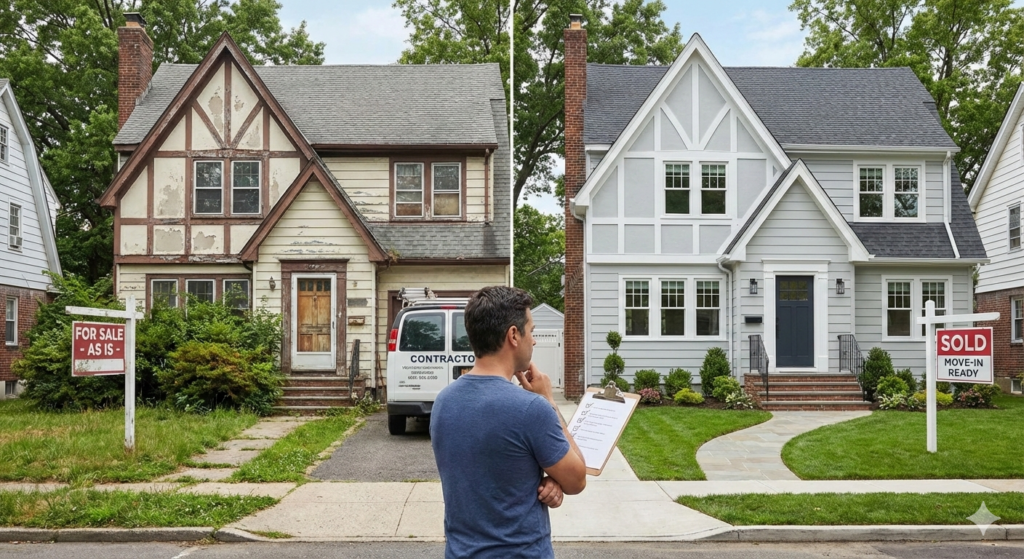
This is one of the most strategic decisions a seller makes, and it is rarely an emotional one once you understand how today’s market actually works. In Queens and on Long Island, most houses already sell functionally as-is, but selective repairs and smart preparation can still put significantly more money in your pocket. The key is knowing what moves the needle and what quietly wastes it.
The first thing sellers need to understand is that the legal landscape has changed. For decades, New York sellers could avoid detailed disclosures by paying a $500 credit at closing. That option no longer exists. As of March 2024, New York State law requires sellers of 1- to 4-family homes to complete a Property Condition Disclosure Statement. You can still market a home as-is, but as-is now means you are not fixing the defects, not that you can hide them.
In practice, this means sellers must disclose what they know about the roof, foundation, plumbing, electrical systems, water intrusion, and other material conditions. Failing to disclose known issues can expose a seller to legal liability after closing. Co-ops and condos are typically exempt, but for houses in Queens, Nassau, and Suffolk, transparency is no longer optional.
Selling as-is does have real advantages. Speed is the biggest one. Even with inventory ticking up slightly in January 2026, supply remains historically low in many areas, with roughly 2 months of inventory in parts of Nassau County. Listing as-is allows sellers to move immediately and capture buyer demand as mortgage rates hover near 6%.
As-is listings also attract cash buyers and investors. Flippers actively look for original condition homes where they can renovate on their own terms. For sellers who value certainty and want to avoid renovation delays, this can be appealing. There is also less risk of opening a can of worms where a small update turns into an unexpected $15,000 repair mid-project.
But as-is is not a free pass. The biggest downside is what I call the hassle discount. Buyers do not just subtract the cost of repairs from their offer. They subtract the stress. If a boiler replacement costs $10,000, a buyer may reduce their offer by $25,000 to compensate for time, uncertainty, and disruption. That discount often surprises sellers.
As-is homes also eliminate a large pool of first-time buyers. FHA and low down payment loans will not approve homes with peeling paint, missing handrails, broken windows, or active leaks. Even minor safety issues can kill a deal during underwriting. As-is does not mean no headaches. It means you trade repair headaches now for negotiation headaches later.
The alternative is fixing strategically, not renovating broadly. In 2026, the data is clear. Smart updates win. Big renovations usually lose.
The highest return almost always comes from preparation, not construction. A professional deep clean and decluttering can deliver outsized results, sometimes exceeding a 3,000% return on cost. A clean, neutral home photographs better, shows better, and feels easier to move into. Smell, clutter, and visual noise matter more than most sellers realize.
Curb appeal is another high-impact area. Replacing a dented garage door or worn front door consistently ranks as the highest ROI project nationally, often recouping more than 190% of cost. In Queens and Long Island, curb appeal functions like a thumbnail image. It determines whether buyers stop scrolling or move on.
Safety and lender red flags should always be addressed. Loose handrails, broken window panes, active leaks, and exposed wiring are relatively inexpensive fixes that protect six-figure mortgages from being denied. These are not cosmetic decisions. They are deal-saving ones.
Where sellers lose money is in major systems and taste-specific renovations. Replacing an old but functioning roof or HVAC system right before listing rarely pays back dollar for dollar. Buyers expect systems to age and often plan upgrades on their own timeline. Similarly, renovating a kitchen or bath with strong personal taste can backfire. Spending $30,000 on finishes a buyer plans to tear out does not increase value. It increases regret.
Today’s market also changes the math. The bidding wars of the past have evolved into calculated competition. As of January 2026, the average home in Nassau County is selling for about 100.4% of list price. That tells us two things. You do not need a perfect house to sell, but you do need a precisely priced one.
Buyers are back as rates settle near 6.1%, but they are more selective. Move-in ready homes are still rewarded. Homes that need work are scrutinized more heavily, and buyers negotiate harder. Pricing and preparation now work together more than ever.
The simplest decision framework is this. If it is a safety issue, fix it, because the bank will force the issue anyway. If it creates a strong negative reaction, clean it, paint it, or remove it. If it requires major renovation, skip it and price accordingly.
In Queens and on Long Island, the smart play is rarely fixing everything or fixing nothing. It is fixing what scares lenders and buyers, disclosing what you know, and pricing the rest honestly. That approach protects your downside and maximizes your leverage in today’s market.
If you are deciding whether to sell as-is or make targeted improvements, the right answer depends on your house, your timeline, and your buyer pool. A clear strategy before you list is what separates confident sellers from frustrated ones.
You can call me directly, or schedule a one-on-one consultation if you prefer a quieter conversation. There’s no obligation. Just clarity about your options and what makes the most sense for you.
Disclosure:
This content is provided for educational and informational purposes only and is not intended as legal, tax, or financial advice. Real estate laws, disclosures, and transaction details vary based on property type, location, and individual circumstances. Homeowners should consult with their own attorney, accountant, or appropriate professional before making any real estate decisions.