
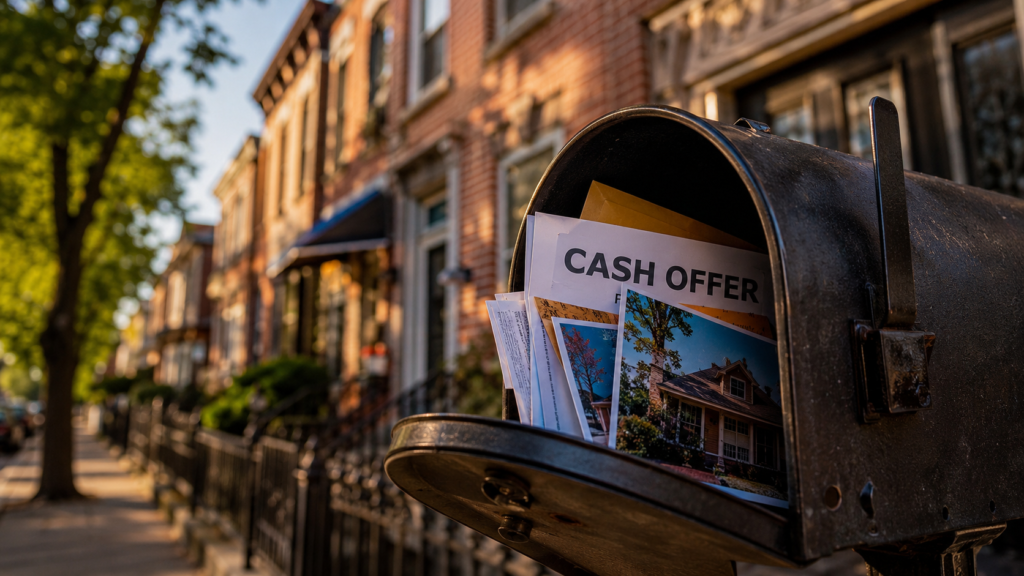
An off-market sale means your home is sold without being listed on the MLS, so it never gets exposed to the full pool of buyers. The investors and wholesalers who send cash offer letters to Queens homeowners rely on this. They need to buy your home below market value, often 10 to 30 percent below, because their profit is the gap between what you accept and what your home is actually worth. In their world, that gap has a name. They call it the spread. And in an off-market deal, the spread comes out of your pocket.
If you own a home in Queens or Brooklyn, especially one you have owned for a long time, you have received these letters. “We buy houses for cash.” “Sell as-is, no repairs, close in two weeks.” Some arrive as postcards. Some as handwritten-looking notes. Some as phone calls that start with “I have a buyer for your block.”
Here is what most homeowners never hear: the person contacting you is not usually the buyer. And the offer is not usually based on what your home is worth. It is based on what they need to pay in order to profit.
The Jargon, Translated Into Plain English
Investors have a vocabulary, and once you understand it, their letters read very differently.
Off market means not listed on the MLS. No public exposure, no competing buyers, no bidding. Just you and one buyer, negotiating in private. Privacy sounds appealing until you realize competition is the only thing that pushes your price up.
The spread is the difference between what you accept and what your home can sell for. If an investor buys your Elmhurst house for $620,000 and it is worth $750,000, the spread is $130,000. That is not a fee you see on paper. It is money that simply never reaches you.
A wholesaler is someone who puts your home under contract, then sells that contract to an actual buyer for a fee before closing. This is called an assignment. Many of the people knocking on doors and sending letters in Queens never intend to buy your home. They intend to sell your signature to an investor for $20,000, $40,000, sometimes more.
ARV, or after repair value, is what your home will sell for once it is renovated. Investors work backward from that number. They take the ARV, subtract renovation costs, subtract their required profit, and what is left becomes your offer. Your home’s current value never enters the math.
As-is means you sell without making repairs. This one is real and can genuinely help, but it is not exclusive to investors. Homes sell as-is on the open market every week in Queens.
Why the Spread Exists at All
The spread exists for one reason: the seller does not know what the property is worth.
Investors are not villains. They are running a business, and the business only works when they buy below market. So they target situations where sellers are least likely to check: estates, longtime owners with paid-off homes, houses in original condition, owners who are overwhelmed by the idea of preparing a home for sale.
Notice what all of those have in common. None of them are pricing problems. They are information problems. And information problems are the cheapest problems in real estate to fix. A comparative market analysis costs you nothing and takes me a few days to prepare.
When Selling Off Market Actually Makes Sense
I am not going to tell you off market is always wrong, because it is not.
Selling off market can make sense when privacy genuinely matters, such as a divorce or a family situation you do not want visible to neighbors. It can make sense when speed outweighs price, like a looming foreclosure date or an estate that needs to settle. And it can make sense when a property has problems so severe that traditional buyers cannot get financing on it.
But even in those situations, you should know the spread before you sign. There is a difference between choosing to trade $40,000 for speed and privacy, and giving up $130,000 because you never found out the number. The first is a decision. The second is a loss.
What To Do Before You Respond to Any Cash Offer
Get the market value first. Not the Zillow estimate, which can miss by six figures on Queens houses with legal two-family potential or R6B zoning upside. An actual analysis of recent sales on your block, by someone who works your neighborhood.
Ask the buyer one question: are you purchasing this property yourself, or assigning the contract? Watch how they answer. A direct buyer answers directly.
Read the contract for assignment language before signing anything. If it says “and/or assigns” after the buyer’s name, the person in front of you is planning to sell your deal to someone else.
And compare the true net. An off-market cash offer has no commission, which sounds like savings. But a $620,000 cash offer with no commission still nets you far less than a $750,000 open-market sale with one. Run both numbers side by side. The math decides, not the marketing.
Frequently Asked Questions
What does “off market” mean in real estate?
Off market means a property is sold without being listed on the MLS or public real estate sites. The sale happens privately between the seller and one buyer, without exposure to competing offers. This usually results in a lower sale price than an open-market listing.
What is the “spread” in an off-market deal?
The spread is the difference between the price a seller accepts and the property’s actual market value or resale price. It is the profit margin for the investor or wholesaler. In off-market deals, the spread typically ranges from 10 to 30 percent of the home’s value.
Are cash offer letters from “we buy houses” companies legitimate?
Many are real offers, but they are almost always below market value. Some senders are wholesalers who never intend to buy your home themselves and plan to assign the contract to another buyer for a fee. Always verify who the actual buyer is before signing.
What is a wholesaler in real estate?
A wholesaler puts a property under contract with the seller, then sells (assigns) that contract to an investor for a fee before closing. The wholesaler profits from the assignment fee without ever owning the property. In New York, wholesaling without proper disclosure or licensing can fall into a legal gray area.
Should I sell my house off market or list it on the MLS?
For most Queens and Long Island homeowners, listing on the MLS produces a higher net price because competing buyers drive up offers. Off market can make sense for privacy, urgent timelines, or severe property conditions, but only after you know your home’s true market value.
How do I find out what my house is really worth before accepting a cash offer?
Request a comparative market analysis (CMA) from a local real estate agent who works in your neighborhood. A CMA uses recent sales of similar homes near you and costs nothing. Online estimates like Zillow can be off by a wide margin on Queens houses with zoning or multi-family potential.
Can I sell my house as-is without going to an investor?
Yes. Homes sell as-is on the open market regularly in Queens and Brooklyn. Listing as-is on the MLS still exposes your home to multiple buyers, including investors who will compete against each other, which typically nets you more than a single private cash offer.
Have a question about your home or your next move in Queens or on Long Island? I answer them every day. Call or text me at 347-612-2964, or schedule a consultation at claudialooi.com/consultation/.
Claudia Looi
Real estate agent in Elmhurst, Rego Park, Forest Hills, and Jackson Heights, and in Deer Park and West Islip on Long Island
Licensed Real Estate Salesperson, SRS, ABR, SFR
Keller Williams Landmark II
347-612-2964 (Cell)
Schedule a consultation: https://claudialooi.com/consultation/