
How Do Co-op Board Approvals Work in Queens?
In Queens, buying a co-op is not just a transaction. It is an application. You can have an accepted offer, a ready lender, and a seller prepared to close, but none of that matters until the co-op board approves you.
This process surprises many buyers, especially those coming from house purchases or from states where board approval does not exist. In a Queens co-op, the board’s approval is what actually unlocks the apartment. Understanding how boards think, what they look for, and how the timeline really works removes a great deal of uncertainty.
What Co-op Boards in Queens Are Actually Looking For
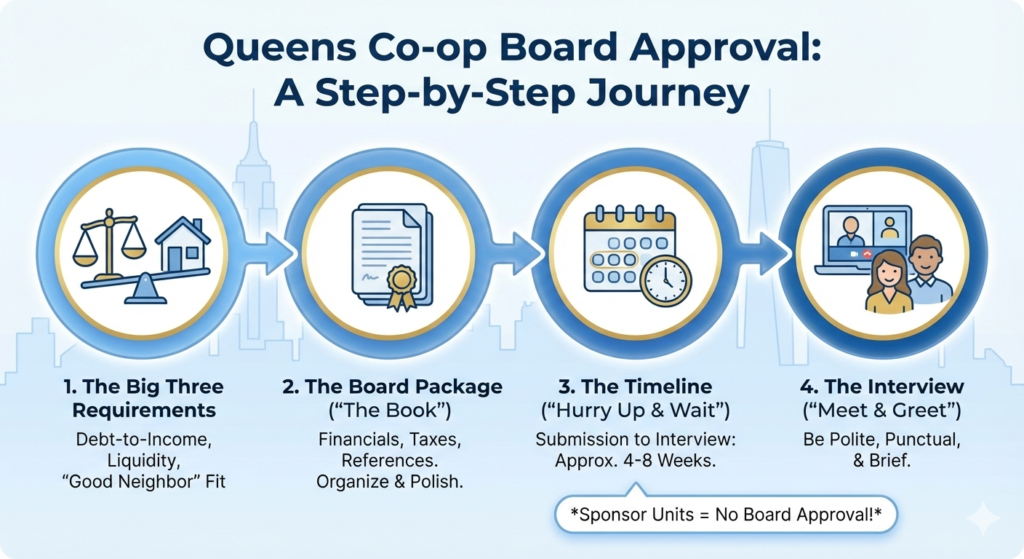
When reviewing applications, most Queens co-op boards focus on 2 main areas: financial stability and community fit.
From a financial standpoint, boards want to see that your housing costs are manageable. They look closely at your income relative to your monthly obligations, including your mortgage payment and the co-op’s monthly maintenance. While standards vary by building, many Queens boards are conservative, particularly in older buildings with limited reserves.
Post-closing liquidity is often just as important as income. After you pay your down payment and closing costs, boards usually want to see that you still have a financial cushion. In many Queens co-ops, it is common to see a requirement of 6 to 12 months of housing payments remaining in liquid assets such as savings, checking, or brokerage accounts.
The second factor is what buyers often call the “good neighbor” component. Boards review reference letters to confirm that you are reliable, respectful, and likely to follow building rules. Simple, consistent references that describe you as responsible and easy to live next to tend to be the most effective.
The Board Package and What It Includes
Once the contract is signed, the board package process begins. This is often referred to as the board package or board book, and it is a detailed snapshot of your financial life.
A typical Queens co-op package includes a personal financial statement outlining assets and liabilities, recent tax returns, pay stubs, and bank statements. Most buildings also require personal and professional reference letters, and some request landlord or employment references.
This stage is where many delays occur. Missing documents, inconsistent numbers, or unclear paperwork can prevent the package from moving forward. In Queens, many boards are run by volunteer members who review applications in their spare time, so a clean, organized submission matters more than buyers expect.
Timeline for Co-op Board Approval in Queens
After submission, the management company reviews the package for completeness before sending it to the board. Once the board receives it, members review the application on their own schedule, often tied to monthly meetings.
In Queens, this review period commonly takes several weeks. Silence during this time is normal and does not mean there is a problem. From package submission to approval, the full board process typically takes about 4 to 8 weeks, though some buildings move faster and others take longer.
The Co-op Board Interview
If the board is comfortable with your application, you will be invited to an interview. By this stage, the board has usually reviewed your financials and sees you as a viable buyer.
Interviews in Queens are generally brief, often lasting 20 to 30 minutes. Some are held in person, while others take place over Zoom. Questions usually focus on lifestyle topics such as pets, work schedules, and why you chose the building.
The best approach is simple. Be polite, punctual, and concise. Boards tend to respond well to buyers who are friendly, respectful, and straightforward.
What Happens After Board Approval: The Lender’s Building Review
Many buyers assume that once the board approves them, the deal is nearly finished. In today’s Queens market, that is often not the case.
In recent months, one of the most common and frustrating delays has been the lender’s review of the building itself. Even after the buyer is approved, the bank still needs to confirm that the co-op meets its lending guidelines before issuing final loan clearance.
This review focuses on the building’s financial health rather than the buyer. Lenders examine reserve levels, owner-occupancy ratios, underlying mortgages, arrears, and whether too many shares are owned by a single entity. If the building’s financial documents are slow to arrive or raise follow-up questions, the timeline can stretch weeks beyond board approval.
This delay is especially common in older Queens co-ops, smaller buildings, or self-managed buildings. It is also more frequent with loan programs that apply stricter review standards. As a result, board approval is no longer the final hurdle. It is a major milestone, but not the last one.
Sponsor Units and Faster Closings
Some listings in Queens are labeled as sponsor units. These apartments are still owned by the original sponsor of the building.
In many cases, sponsor units do not require full board approval. The process is often faster and involves far less paperwork, making it more similar to buying a condo or a house. For buyers who want a quicker and more predictable timeline, sponsor units can be an attractive option.
Final Thoughts on Buying a Co-op in Queens
The co-op board approval process has more steps than buying a house, but it follows a clear rhythm once you understand it. Organization, preparation, and realistic expectations go a long way.
My role is to help buyers navigate this process with clarity. That includes understanding what a specific Queens building typically expects, organizing financial information, anticipating lender requirements, and submitting a polished package that reduces delays and uncertainty.
You can call me directly, or schedule a one-on-one consultation if you prefer a quieter conversation. There’s no obligation. Just clarity about your options and what makes the most sense for you.
Disclosure:
This content is provided for educational and informational purposes only and is not intended as legal, tax, or financial advice. Real estate laws, disclosures, and transaction details vary based on property type, location, and individual circumstances. Homeowners should consult with their own attorney, accountant, or appropriate professional before making any real estate decisions.