
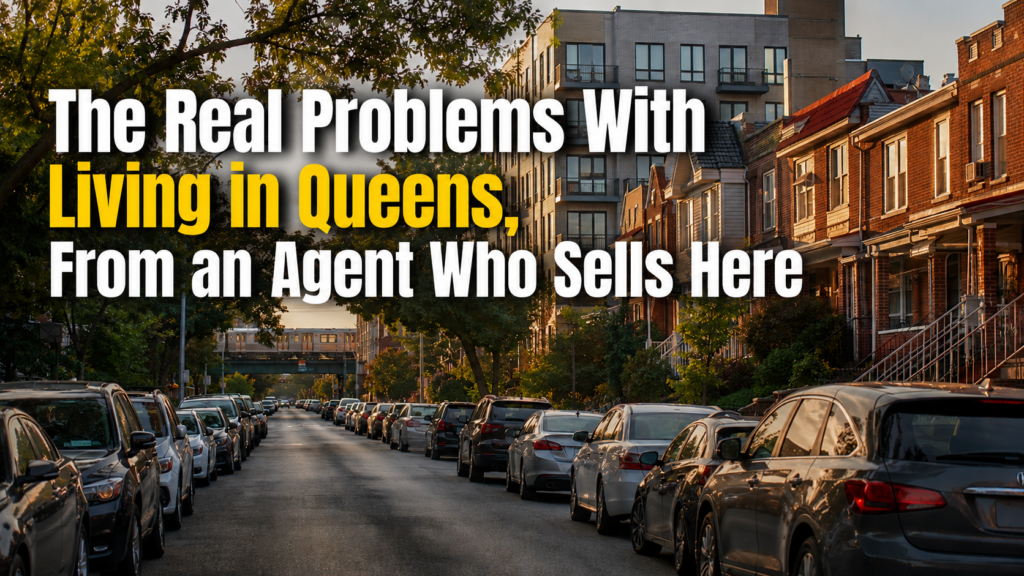
The main problems with living in Queens are high cost, uneven subway access, traffic and tight parking, noise near the airports, and a sharp divide between newer and older parts of the borough. Cost of living runs about 54% above the national average, and a one-bedroom rents for around $3,023 a month. The subway is strong on the western side and thins out as you move east and south, which means some commutes that look short on a map take close to an hour. Parking is competitive in the denser neighborhoods, and flight paths make noise a constant near both airports.
That is the honest list. But most of these are not reasons to avoid Queens. They are reasons to choose your spot carefully and know what you are signing up for. Know, not guess.
I sell homes here. I sit across the table from people deciding whether to stay or go. So the rest of this is the version you will not get from a generic moving guide: what each problem actually means day to day, and how the right neighborhood solves most of them.
The cost is the first thing everyone names
Living in Queens runs about 54% above the national average. That is the headline, and it is true. The borough-wide average for a one-bedroom sits right around $3,023 a month.
That average hides a wide spread, and the spread is the part that matters. Luxury waterfront pockets push north of $4,400. More established residential areas land closer to $2,600 to $2,700. Same borough, very different rent, depending on where you look. The average is almost useless until you narrow it to the kind of neighborhood you actually want.
Here is what the generic guides leave out. Queens is still meaningfully cheaper than Manhattan or Brooklyn for what you get. A co-op here often sells for a fraction of a comparable condo. If you are open to a co-op and can pass board approval, your dollar stretches further than almost anywhere else in the city.
The cost is real. It is also negotiable, depending on what you are willing to consider.
Not every corner of Queens has a subway
This is the complaint I hear most from people moving in from outside the city. They assume Queens works like Manhattan, where a train is always three blocks away. It does not.
The western side is exceptionally well connected to Manhattan. Move east and south and the subway thins out fast. Those areas lean on the Long Island Rail Road and local or express buses instead of a nearby train. Getting into Manhattan is usually easy. Getting across the borough, or over to Brooklyn or the Bronx, often means looping back through Manhattan or riding a slow bus line. That is how a trip that looks short on a map turns into close to an hour.
So where you land determines your daily commute more than almost any other factor. Two homes a few miles apart can mean two completely different lives, depending on the nearest train.
Traffic, parking, and the car question
Queens has higher car ownership than Manhattan or Brooklyn, and you feel it. Rush hour on the main parkways and expressways is slow. Parking in the denser neighborhoods is a genuine headache, and street parking can turn into a nightly hunt.
This is where buying beats renting for a lot of people. A house or a co-op with a deeded spot or a driveway removes a daily stress that renters absorb for years. It is not a small thing. For rightsizers especially, losing the parking fight is one of the quiet reasons people finally decide to move.
Noise, density, and air
Queens holds both JFK and LaGuardia, and some neighborhoods sit directly under major flight paths. In those pockets the noise is constant. Dense blocks mean less privacy and more street activity. Heavy traffic affects air quality in the busiest corridors.
None of this is uniform. The borough holds tree-lined streets with detached homes and quiet backyards, and it holds packed avenues that never slow down. The trick is matching the setting to how you actually want to live. Someone craving calm and someone craving energy can both be happy here. They just should not buy on the same block.
The split between old and new
Some parts of Queens have seen heavy development and modern buildings. Others carry older housing stock and infrastructure that shows its age. That is not automatically bad. Older homes often sit on bigger lots, in established communities, at prices the new towers cannot touch.
But it means you cannot generalize about “Queens.” A buyer needs to read each pocket on its own terms. The borough is too varied for a single verdict.
Why this matters if you are thinking about your next move
Most people who type “problems living in Queens” are really asking one question. Is this a mistake. Usually it is not. The drawbacks are manageable when you choose with open eyes, and the upside is hard to match. You get space, ownership, community, and proximity to everything, often at a lower entry point than the boroughs next door.
The mistakes happen when people buy on a feeling instead of the facts. They fall for a kitchen and ignore the commute. They skip the parking question until it is too late. They assume every neighborhood works the same way.
That is the part I help with. Not talking you into Queens, and not talking you out of it. Showing you which version of Queens fits the life you are trying to build, and which one would wear you down.
Frequently Asked Questions
Is Queens a good place to live?
For most people, yes. It offers more space and lower entry prices than Manhattan or Brooklyn, strong diversity, and easy access to the rest of the city. The main tradeoffs are cost, uneven subway coverage, and traffic, all of which depend heavily on the neighborhood you choose.
Why is Queens so expensive?
Queens sits about 54% above the national cost of living, with housing as the biggest driver. The average one-bedroom rents for around $3,023 a month. It is still less expensive than Manhattan or Brooklyn, but well above most of the US.
Is it hard to get around Queens without a car?
It depends where you live. The western part of the borough has strong subway access to Manhattan, while eastern and southern areas have fewer trains and lean on the Long Island Rail Road and buses. Cross-borough trips often require looping through Manhattan, which adds time.
Is buying in Queens worth it compared to renting?
For many buyers, yes, especially given how much rent has climbed. Owning a co-op or a home with parking can remove costs and daily stresses that renters absorb indefinitely. The right answer depends on your timeline, finances, and target neighborhood.
What is the cheapest way to buy in Queens?
Co-ops are typically the lowest entry point, often selling for far less than comparable condos. The tradeoff is the board approval process and monthly maintenance. For the right buyer, that tradeoff is well worth the savings.
Is parking a problem in Queens?
In the denser neighborhoods, yes. Queens has higher car ownership than Manhattan or Brooklyn, so street parking can be competitive. A home or co-op with dedicated parking solves a daily frustration that affects a lot of residents.
Should I talk to a real estate agent before moving to Queens?
Yes. The borough varies dramatically from one neighborhood to the next, and the right local guidance helps you match your budget and lifestyle to the right area. A good agent saves you from buying into a setting that looks fine on paper but does not fit your life.
Have a question about your home or your next move in Queens or on Long Island? I answer them every day. Call or text me at 347-612-2964, or schedule a consultation at claudialooi.com/consultation/.
Claudia Looi
Real estate agent in Elmhurst, Rego Park, Forest Hills, and Jackson Heights, and in Deer Park and West Islip on Long Island
Licensed Real Estate Salesperson, SRS, ABR, SFR
Keller Williams Landmark II
347-612-2964 (Cell)
Schedule a consultation: https://claudialooi.com/consultation/